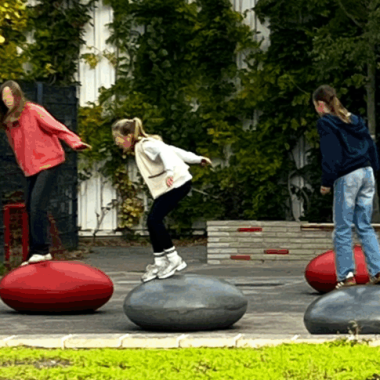
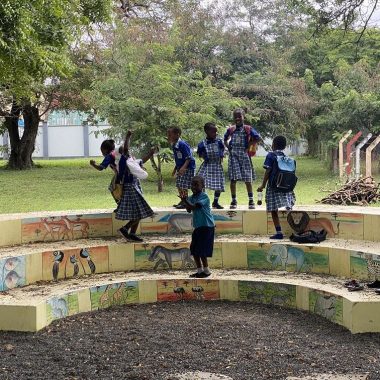
Many traditional schoolyards lack diversity in design. Boys tend to be more active and occupy the largest part of the area, while girls are less active, and are in the periphery of the area. Across different contexts, areas for children and teenagers are often designed around activities that primarily attract one group of users, limiting accessibility or activity for all.
With Space for Play, we actively challenge this pattern. In 2020 we already wrote about this phenomenon (Space for Play’s paper: “What is a truly inclusive city for children & teenagers?” Who’s city is it?) and were invited to give a presentation about it (Presentation: “What can we as urban designers do to stimulate equal use of play space by boys and girls?’ Gender-inequity starting at schoolyards.).
We design diverse and inclusive environments in which users move beyond gendered assumptions. Together with all usergroups, we design spaces where every child feels welcome, represented, and free to play in their own way; spaces encouraging interaction, cooperation, and shared experiences.
Our expertise
At Space for Play, we strongly believe in the power of play as a fundamental driver of children’s development and well-being, grounded in five key principles: The right to play, learning through play, climate & play, equality of play, and inclusive play.
Advocating for play: Every child has the right to play. This is recognised in Article 31 of the United Nations Convention on the Rights of the Child.
At Space for Play, this principle lies at the heart of our work. We are committed to providing accessible free spaces to play for all children, focusing on the high density urban areas where children do not have Permission or Place to play. Play is not a luxury, but a fundamental right.
We help children to advocate for their rights, by educating and empowering them. We advocate for this right by presenting to policymakers and educators; by training architects and urban designers how to design for play, together with children.
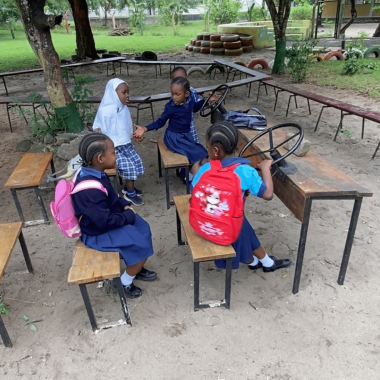
The space is a child’s third teacher (educators, parents & space). Children develop skills through play, which they don’t learn in class.
- In our schoolyard designs, we integrate educational and pedagogic needs: the designed spaces invite children to specific play, developing exactly the skills in their zone of proximate development.
- In free outdoor play children develop physical, social, emotional, and cognitive skills.
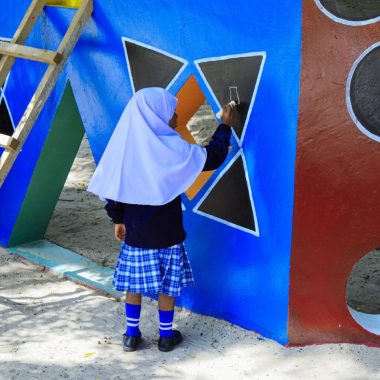
- In our spaces children find places stimulating them to climb and fall safely, to imagine, or vent their frustrations, to estimate risks, to collaborate, to express themselves, to learn, to grow their independence and their resilience.
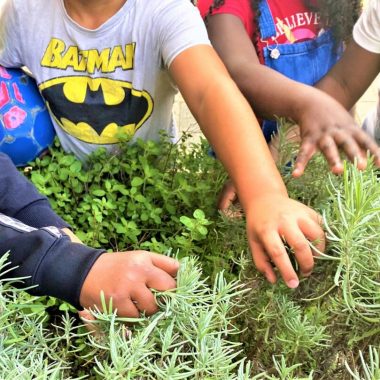
- We integrate indigenous nature, as interaction with nature improves children’s emotional wellbeing, encourages curiosity, increases concentration after play, and nurtures a deeper connection with the world around them.
At Space for Play, we create spaces where learning happens naturally.
Creating safe yet challenging play spaces that nurture children’s innate desire to connect with nature, is one of our core areas of expertise.
Our children will suffer more from the climate crisis than we adults. At Space for Play, we see it as our duty to co-create climate adaptive spaces for and with children & youth. We integrate climate-adaptive solutions that benefit not only children – providing them with cooling, safe, green play spaces – but also benefit their communities and the wider city.
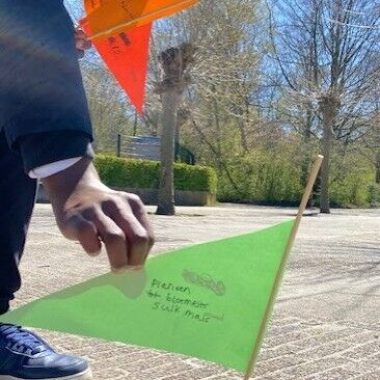
These principles are not only at the core of our designs, but also formed the basis of our participatory process: Children and youth learn in climate classes, design innovative solutions in design workshops, they are empowered in collective planting and construction, and collectively maintain their green places.
Globally, children with disabilities face many challenges in daily life. They have special needs, but in play they have the same needs as other children: to have fun, to socialize or observe, to reach their goals, to join in, to forget, fantasise and learn through play.
We have become global experts in designing play spaces for special needs children, thinking beyond universal or inclusive design: We design places where all children can find their own challenges and play together, where children with disabilities can forget their disabilities, and can grow their abilities through play.
We have designed play spaces for schools with:
- Children with hearing and speech impairment (Gouda, De Triangel)
- Children on the autistic spectrum (current project: Cambodia, The Rabbit school)
- Children with physical disabilities (Egypt, Cairo, Center of Love; Hilversum De Trappenberg)
- Children facing socio-emotional or behavioural challenges (Amsterdam Van Houte, Zijdelwaard Het Kabouterhuis)
- Children with special needs or learning difficulties (Amsterdam Het Universum)
- Blind children or with visual impairments (current project: South Africa, The Arthur Blaxall school)